For anyone working with backup power, there are many different options that you may have run into. One choice is battery storage. Battery storage offers a means of storing electricity that can be dispatched later when it’s needed. However, there are many different forms that battery storage can take within power systems. A Battery Energy Storage System (BESS) and an Uninterruptible Power Supply (UPS) both provide backup power to a site or microgrid. A BESS vs a UPS operate in different ways, and each device serves a different purpose.
Battery Energy Storage System: BESS
A BESS is an energy storage device designed for storing large amounts of power for slow continuous discharge.
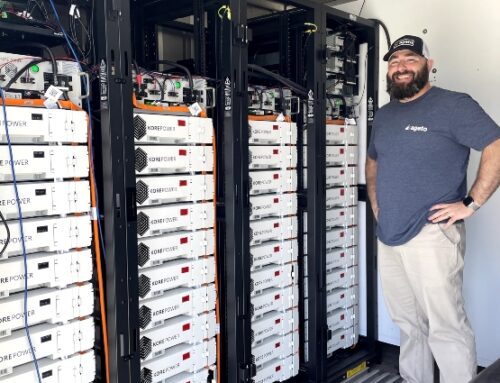
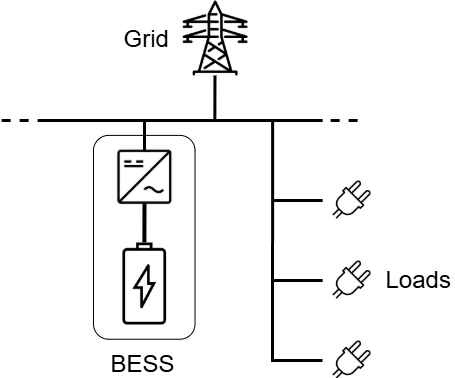
The typical design of a BESS includes multiple battery cells packaged into modules. These modules are stacked in racks and connected together in series. Finally, the chain of batteries is connected to a bidirectional inverter: a device which is capable of sending or receiving AC power to or from the grid. Examples of BESS designs can be found here.
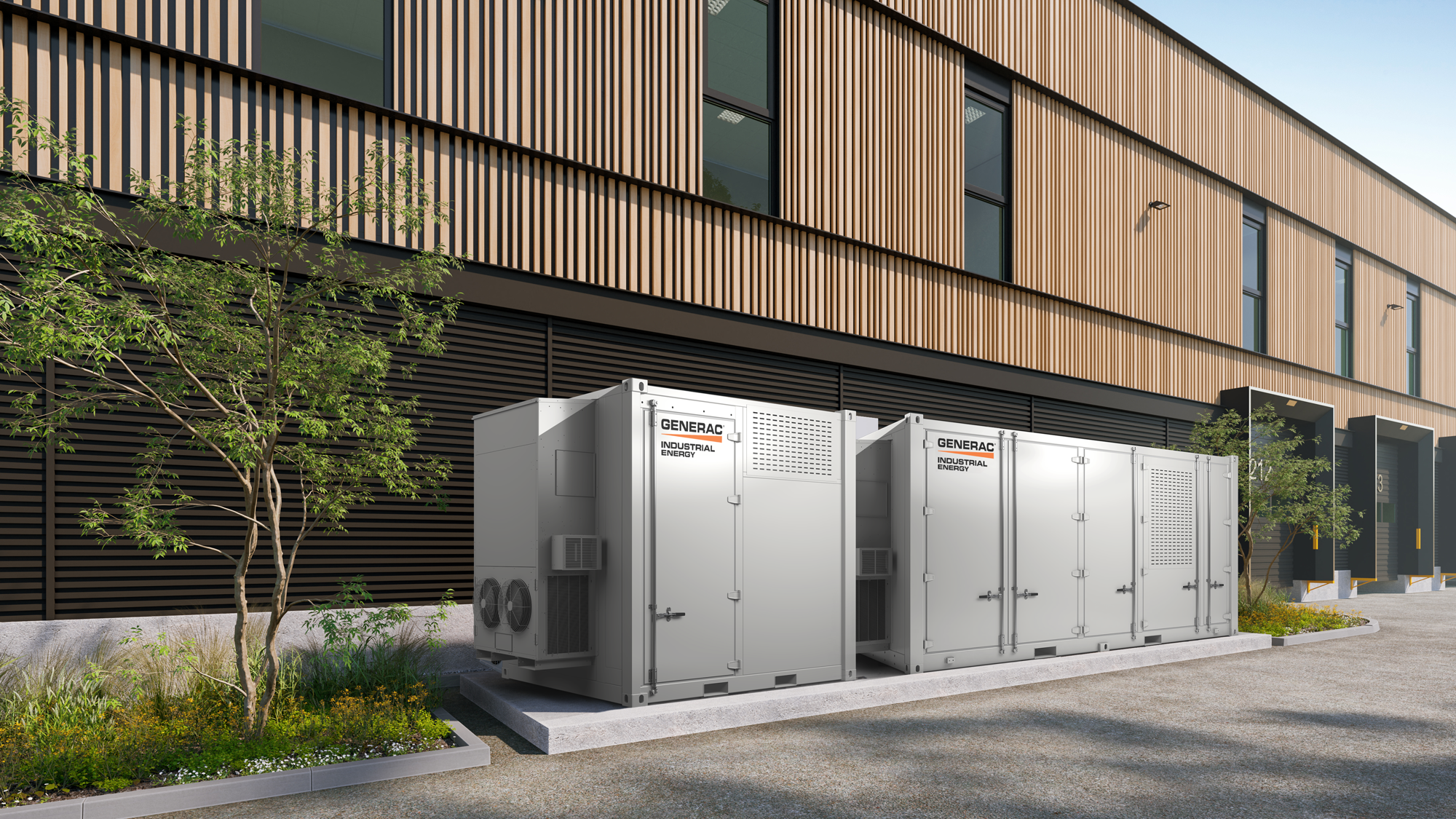
A BESS can be cooled with ambient air, HVAC, or liquid, depending on the BESS design and operating environment. They are usually stored outdoors due to their large size and the fire risks associated with batteries at this scale.
A BESS typically plays an active role in the grid. It may be used for utility bill savings, market participation, or backup power.
Uninterruptible Power Supply: UPS
A UPS is an energy storage device designed for providing a stable and uninterrupted power supply to devices.
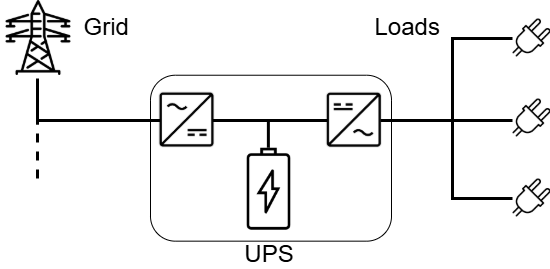
The typical design includes two inverters sandwiching a DC link. The DC link is parallel with the batteries. The batteries are packaged in modules, and then, depending on size of the UPS, are connected together in series. A smaller UPS may only need one module. With the battery system in parallel with the DC link, we can hold a stable voltage that resists change from the grid. The first inverter will set this voltage with the batteries holding and releasing it based on their state of charge. A UPS typically only operates in a single direction.
A UPS is usually located close to the devices that it is powering, and this lands them indoors. They typically rely on ambient air supplied by the HVAC within the facility for cooling but can be equipped with their own specific system for special circumstances.
A UPS can range from a small device that sits on a desk to provide uninterrupted power to your PC to large installations backing up industrial loads.
BESS vs. UPS
Off-Grid Operation
So why two distinct designs for battery storage? The largest differentiation between a BESS vs a UPS is the intended purpose. Let’s compare how each device would operate in a utility failure scenario.
A BESS could be implemented to run a full facility in the event of an outage. Here, the BESS is the relied upon source of energy while the utility is down. An example facility with a BESS can be found here. But what about a UPS vs a BESS? A UPS is not designed to be the direct source. Rather, a UPS would provide continuous power to a device or set of devices temporarily. A UPS will run until other forms of power generation (such as generators) can start up and take over.
Usually, UPS devices are designed to operate for just a few minutes, up to around half an hour. A BESS would be a better option for a backup power source in the event of a more extended outage. It can be fitted to provide backup power to a facility for a few hours on its own. (typically, between 2 and 4 hours)
On-Grid to Off-Grid Transition: Microgrids
Because of the in-series double conversion setup, the transitional period for a UPS is instantaneous. Connected devices would see no break in power. A BESS relies on fast inverter mode switching technology to complete this transition. The transition speed of BESS can vary depending on the inverter. Some inverters may take seconds to switch into a backup mode.
For other BESS such as the Generac SBEs, the transition occurs in under 50ms. This transition can be as quick as only 15ms. This is quick enough to prevent a noticeable flicker in the lights but is still not truly uninterrupted. For applications with high power and rapid computational requirements, such as servers or data centers, the turnover from a BESS vs a UPS may not be adequate.
Location in the Grid
Due to each device’s underlying architecture, a system considering implementing a BESS vs a UPS will be designed differently.
A BESS is located in parallel with the loads and the utility provider, as opposed to in series with them. This allows the BESS to be both charged by distributed energy resources and the utility when energy is in surplus. It can then be discharged back to the loads when there is an energy shortage. Any devices that are on the network will receive power from the BESS as needed.
With a UPS being in series with its targeted load group, it provides the load side with continuous power. Anything behind the UPS will remain powered down in the event of an outage. While technology for a bidirectional UPS exists, it requires an additional bidirectional inverter relative to a BESS. This bumps the cost of the device and doesn’t add major functionality. The devices a UPS may be powering are typically not power generating devices.
Grid Stabilization
Both a BESS and a UPS can be used to achieve a more stable grid. Choosing between a BESS vs a UPS to achieve device stabilization depends on the devices in question.
A BESS helps to stabilize the entire site. A BESS is capable of injecting and absorbing both active and reactive power into and from the grid. This can help maintain the frequency of the grid through fast frequency response. This is useful in the event that local devices come online, offline, or the grid itself becomes briefly unstable.
A UPS acts as a filter of sorts. It is able to create its own stable waveform on the load side through converting AC to DC and back to AC. Any fluctuations from the grid get dissipated by the voltage held by the battery system within the UPS. Therefore, a UPS is acting to protect its loads, and it does little to provide support to the rest of the grid.
Conclusion
Seeing the two devices side by side shows how each one shines in its respective applications. While both a BESS and UPS are designed to address different problems, it is important to note that there are many applications where a BESS and a UPS can work together. The devices are not exclusive of one another within a local power grid.
Table 1: BESS Vs UPS Rapid Comparison
| Category | BESS | UPS |
|---|---|---|
| Off-Grid Operation | Source of energy for the local power grid | Source of energy for connected load group |
| Power Duration | Typically 2-4 hours | Typically just a few minutes |
| On-Grid to Off-Grid Transition | As low as 15-50 ms transition time | Instantaneous transition |
| Grid Location | Parallel with the utility and the local grid loads | In series with the utility and the local grid loads |
| Grid Stabilization | Stabilization across all devices | Stabilization to connected load group only |
Both BESS and UPS have their own niches within a power system. With a BESS capable of providing large scale facility backup power for multiple hours, and a UPS providing reliable power to critical infrastructure, the two devices both play critical roles in maintaining the functionality of the site during a utility outage. Both a BESS and a UPS can be seen working together for larger facilities to help ensure seamless operation 24 hours a day, 365 days a year.